
Understanding business value: Part 2
Jul 20, 2026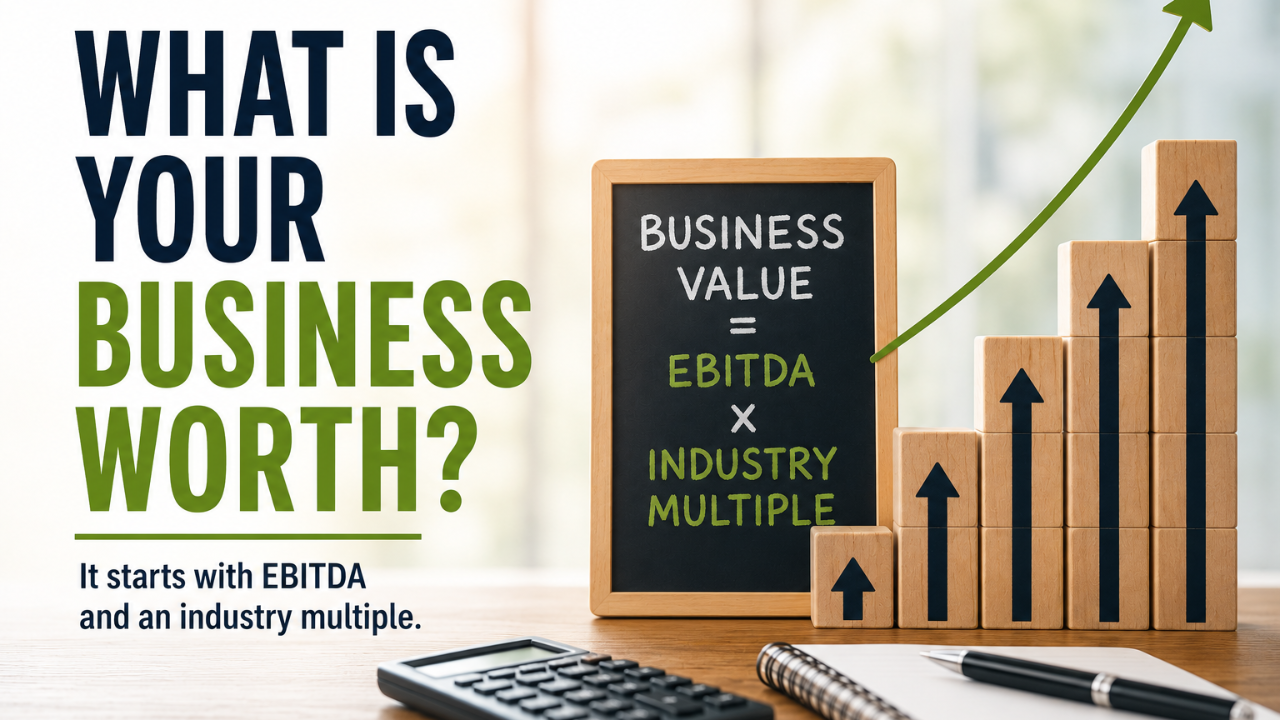
Understanding business value and why two successful businesses can have very different price tags.
Have you ever wondered what your business is actually worth?
Maybe you've joked with your spouse about selling it someday. Maybe you've had someone ask if your business was for sale. Or perhaps you've simply been curious after hearing about another business that sold for what seemed like an unbelievable amount of money.
It's a question almost every business owner eventually asks.
Unfortunately, it's also one of the most misunderstood questions in business.
Many owners immediately think about annual sales. Others focus on how much profit they made last year. Some even estimate the value based on what they've invested over the years.
While those things all play a role, they don't necessarily determine what someone is willing to pay for your business.
In last week's blog, we talked about EBITDA and how it provides a clearer picture of a business's operating performance. This week, we're taking the next step by looking at how that number is often used to estimate business value.
Even if you have no plans to sell your business, understanding what creates value can completely change how you lead it today. Because the same things that make a business more valuable also tend to make it healthier, more efficient, and more enjoyable to own.
Let's look at why.
- Your Business Is Worth More Than Its Revenue
One of the biggest misconceptions I hear from business owners is that the value of their business is based on annual sales.
"I did three million dollars last year, so my business must be worth about three million."
Unfortunately, it doesn't work that way.
Revenue is important because it tells us how much business is coming through the door. But revenue doesn't tell us how efficiently the business operates, how profitable it is, or whether it can continue performing well in the future.
Think about two restaurants that each generate two million dollars in annual sales.
One has a loyal management team, consistent profits, and systems that allow it to operate smoothly every day.
The other depends entirely on the owner, struggles with staffing, and barely breaks even.
From the outside, they may look similar.
To a buyer, they're completely different businesses.
That's why buyers look beyond revenue. They're trying to understand not only what the business has done, but what it is likely to do in the future.
- Buyers Are Investing in the Future, Not the Past
One of the biggest shifts in thinking happens when you stop looking at your business through the eyes of an owner and begin looking at it through the eyes of a buyer.
As owners, we naturally think about all the years we've invested.
The long nights.
The risks.
The sacrifices.
The countless decisions that brought the business to where it is today.
Buyers certainly appreciate that history, but they aren't paying for yesterday.
They're investing in tomorrow.
They're asking questions like:
Will this business continue to perform well after the current owner leaves?
Does it have room to grow?
Are the customers loyal?
Is the leadership team strong?
Can the business operate without the owner making every decision?
Those answers often have just as much influence on value as the financial statements themselves.
- EBITDA Multiples Are a Starting Point—Not the Final Answer
In the previous blog, we talked about EBITDA as a way to measure the operating performance of a business.
One of the most common ways buyers estimate value is by multiplying EBITDA by an industry multiple.
The basic formula is simple:
Business Value = EBITDA × Industry Multiple
For example, if a business has an EBITDA of $500,000 and businesses in that industry commonly sell for around five times EBITDA, the estimated value would be about $2.5 million.
That sounds straightforward, but here's where many people get confused.
The multiple isn't automatically five.
Or four.
Or six.
It depends.
Every industry has its own typical range, and every business falls somewhere within that range based on its strengths and weaknesses.
That's why two businesses with nearly identical EBITDA can still sell for dramatically different amounts.
- Healthy Businesses Earn Better Multiples
If I could simplify business valuation into one sentence, it would probably be this:
Healthy businesses usually receive healthier valuations.
Businesses that are organized, financially stable, and well-managed naturally reduce risk for a buyer.
Think about the kinds of businesses you would want to own.
One has documented systems, experienced employees, loyal customers, clean financial statements, and opportunities for future growth.
The other depends entirely on one owner, has inconsistent profits, outdated processes, and constant employee turnover.
Both may generate similar profits today.
Which one feels like the safer investment?
That's exactly how buyers think.
The multiple they apply isn't just based on profit. It's based on confidence.
The more confidence a buyer has in the future of the business, the more valuable that business often becomes.
- Focus on Building a Better Business—The Value Will Follow
Sometimes business owners become fascinated with the multiple.
They ask,
"How do I get a seven-times multiple instead of five?"
While that's an understandable question, I don't think it's the best one.
A better question is,
"What can I do to build a stronger business?"
When you improve your leadership, your operations become stronger.
When you improve your financial systems, your numbers become more reliable.
When you improve customer experience, loyalty increases.
When you improve marketing and sales, growth becomes more predictable.
Notice something?
Those are the same five core areas we focus on every day at Thrive Business Consulting.
That's because healthy businesses naturally become more valuable businesses.
The goal shouldn't be chasing a higher multiple.
The goal should be building a business that deserves one.
Conclusion: Build Value Every Day
One of the biggest surprises for many business owners is realizing that business value isn't something you discover when you're ready to sell.
It's something you build every single day.
Every documented process.
Every leader you develop.
Every customer relationship you strengthen.
Every financial improvement you make.
Every operational problem you solve.
All of those things contribute to the long-term value of your business.
Whether you sell your business five years from now, twenty years from now, or never at all, those improvements make your business stronger today.
That's why understanding business value isn't really about selling your business.
It's about building one that's healthy enough to thrive for years to come.
Next week, we'll finish this series by looking at 10 practical ways you can intentionally increase the value of your business, regardless of whether selling it is part of your future plans.
Thrive Action Tip
This week, stop asking,
"What is my business worth?"
Instead, ask,
"What can I improve that would make my business more valuable one year from today?"
The answer probably won't be found in a spreadsheet.
It will likely be found in stronger leadership, better systems, healthier finances, and a better experience for your customers.
Those intentional, consistent, and incremental improvements don't just increase the value of your business—they make it a better business to own.
Don't just survive, THRIVE.