
Understand What Your Business Is Worth
Jul 13, 2026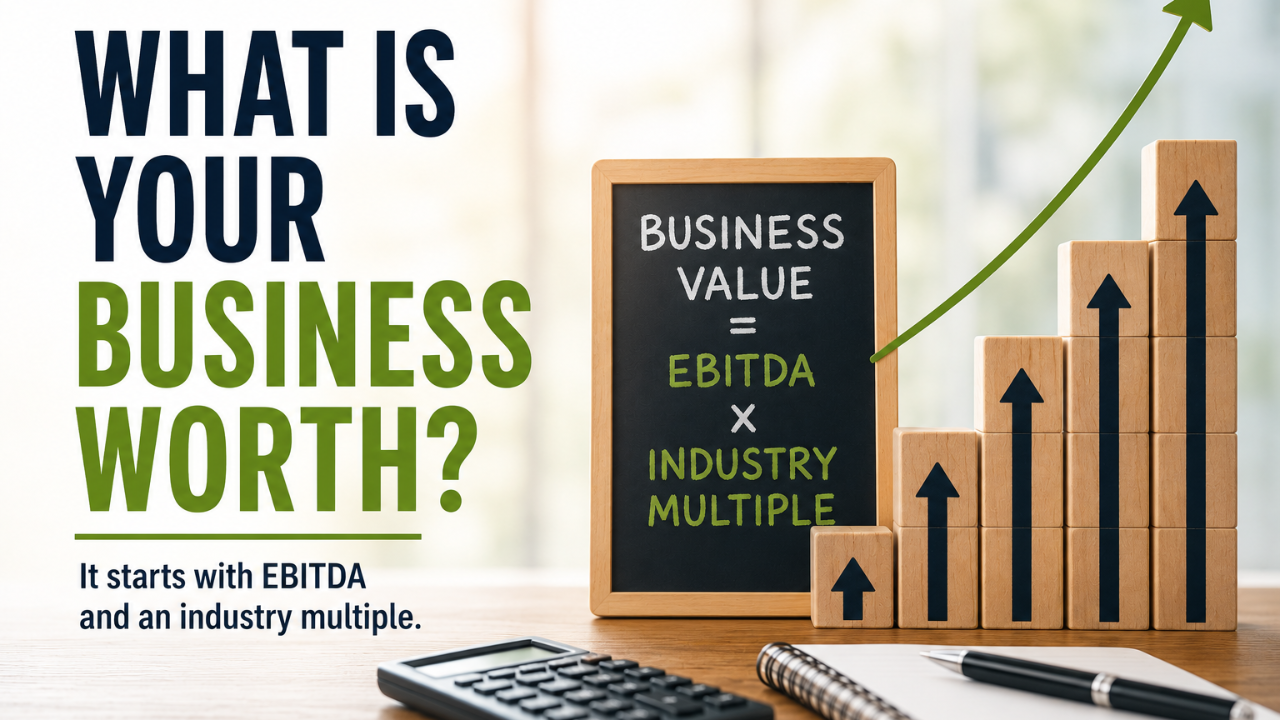
Why Every Business Owner Should Know Their Value Before They Need It
If I asked you today, "What is your business worth?" how confident would you be in your answer?
Most business owners can tell you their annual revenue. Many know whether they made a profit last year. Some even know what their balance sheet looks like. But surprisingly few know what someone might actually pay to buy their business.
For many owners, the answer is simply, "I don't know."
That may not seem like a problem if you aren't planning to sell anytime soon. But understanding the value of your business isn't just about preparing for retirement or finding a buyer. It's one of the best ways to measure the health of your business today and identify what needs to improve for tomorrow.
In our previous blog, we talked about EBITDA and why it has become one of the most important measurements buyers, lenders, and investors use to evaluate a business. EBITDA helps measure the true operating performance of a company by focusing on the earnings the business generates before financing, taxes, and accounting decisions.
Once you know your EBITDA, the next question becomes, "What is it worth?"
The answer usually starts with something called an EBITDA multiple.
- Your Business Value Usually Starts with EBITDA
Think of EBITDA as the foundation of your business value.
While there are many factors that influence the final selling price of a business, most professional buyers begin by taking the company's annual EBITDA and multiplying it by an industry multiple.
The basic formula looks like this:
Business Value = EBITDA × Industry Multiple
For example, if your business generates $500,000 in EBITDA and similar businesses typically sell for five times EBITDA, your estimated business value would be approximately $2.5 million.
That doesn't mean your business will automatically sell for that amount. It simply provides a logical starting point for determining value.
This is one reason improving your EBITDA can have such a dramatic impact. Every additional dollar of EBITDA doesn't just increase profit—it can increase the overall value of your business by several dollars.
- Every Industry Has Different Multiples
One of the biggest misconceptions business owners have is assuming all businesses are valued the same way.
They aren't.
Different industries carry different levels of risk, growth potential, recurring revenue, customer loyalty, and capital requirements. Because of that, buyers are willing to pay very different multiples depending on the type of business.
For example, many small manufacturing companies may sell for a lower multiple than a software company with recurring subscription revenue. A medical practice may receive a different valuation than a retail store. Professional service businesses often have different multiples than construction companies or restaurants.
Even within the same industry, two companies with similar revenue may receive very different valuations because one business is more stable, more profitable, or less dependent on the owner.
The important lesson is this: don't compare your business to someone else's unless they're truly comparable. Industry matters.
- Size Matters More Than Many Owners Realize
Business size also plays a significant role in valuation.
Generally speaking, larger businesses often receive higher EBITDA multiples than smaller businesses.
Why?
Because larger companies typically have stronger management teams, more diversified customers, better financial reporting, established systems, and less dependence on one individual.
Buyers see these businesses as lower risk.
A small business generating $300,000 of EBITDA may receive a much lower multiple than a business generating $3 million of EBITDA, even if they operate in the exact same industry.
This is one reason business owners should continually work toward building systems, developing leaders, strengthening processes, and reducing owner dependence. These improvements don't just make the business easier to operate—they often make it significantly more valuable.
- Valuation Is More Than Just a Formula
While EBITDA multiples provide a great starting point, no business is valued by math alone.
Buyers also ask important questions.
How dependent is the business on the current owner?
Are customers diversified or concentrated?
How stable are profits?
Is there recurring revenue?
Are financial records clean and accurate?
Are employees likely to stay after the sale?
Is there opportunity for future growth?
Each of these questions either increases or decreases the perceived risk of buying the business.
Lower risk generally leads to higher valuations.
Higher risk usually results in lower offers.
This is why building a valuable business is really about building a healthy business.
- Knowing Your Value Helps You Make Better Decisions Today
One of the greatest benefits of understanding your business value has nothing to do with selling.
It helps you make better decisions today.
When you understand what drives business value, your priorities begin to change.
You start focusing more on improving profitability rather than simply increasing sales. You build better systems instead of relying on yourself to solve every problem. You invest in leadership development, customer retention, financial controls, and operational efficiency because you understand these improvements create long-term value.
Whether you plan to sell in two years, twenty years, or never, knowing what your business is worth gives you a clearer picture of where your business stands today and where you want it to go tomorrow.
The healthiest businesses are rarely built by accident. They are built intentionally, consistently, and incrementally.
And over time, those small improvements don't just make your business easier to run.
They make it more valuable.
Final Thoughts
Every business owner should know three important numbers:
- Your annual revenue.
- Your annual EBITDA.
- Your estimated business value.
These numbers provide a much clearer picture of your business than revenue alone ever could.
Your valuation is not simply about preparing for an eventual sale. It's a report card on the health of your business and a roadmap for increasing its future value.
The more you understand what creates value, the better decisions you'll make every single day.
Thrive Action Tip
Calculate your current EBITDA and research the typical EBITDA multiple for businesses in your industry. Then ask yourself one important question:
"What is one improvement I could make this year that would increase both my profitability and the value of my business?"
Remember, great businesses aren't built overnight. They are built intentionally, consistently, and incrementally.
Don't just build a business that survives. Build one that truly Thrives.